Monday, December 22, 2008

The Quit India speech by Mahatma Gandhi


August 8th 1942

Before you discuss the resolution, let me place before you one or two things, I want you to understand two things very clearly and to consider them from the same point of view from which I am placing them before you. I ask you to consider it from my point of view, because if you approve of it, you will be enjoined to carry out all I say. It will be a great responsibility. There are people who ask me whether I am the same man that I was in 1920, or whether there has been any change in me. You are right in asking that question. 
Let me, however, hasten to assure that I am the same Gandhi as I was in 1920. I have not changed in any fundamental respect. I attach the same importance to non-violence that I did then. If at all, my emphasis on it has grown stronger. There is no real contradiction between the present resolution and my previous writings and utterances. 
Occasions like the present do not occur in everybody’s and but rarely in anybody’s life. I want you to know and feel that there is nothing but purest Ahimsa1 in all that I am saying and doing today. The draft resolution of the Working Committee is based on Ahimsa, the contemplated struggle similarly has its roots in Ahimsa. If, therefore, there is any among you who has lost faith in Ahimsa or is wearied of it, let him not vote for this resolution. 
Let me explain my position clearly. God has vouchsafed to me a priceless gift in the weapon of Ahimsa. I and my Ahimsa are on our trail today. If in the present crisis, when the earth is being scorched by the flames of Himsa2 and crying for deliverance, I failed to make use of the God given talent, God will not forgive me and I shall be judged un-wrongly of the great gift. I must act now. I may not hesitate and merely look on, when Russia and China are threatened. 
Ours is not a drive for power, but purely a non-violent fight for India’s independence. In a violent struggle, a successful general has been often known to effect a military coup and to set up a dictatorship. But under the Congress scheme of things, essentially non-violent as it is, there can be no room for dictatorship. A non-violent soldier of freedom will covet nothing for himself, he fights only for the freedom of his country. The Congress is unconcerned as to who will rule, when freedom is attained. The power, when it comes, will belong to the people of India, and it will be for them to decide to whom it placed in the entrusted. May be that the reins will be placed in the hands of the Parsis, for instance-as I would love to see happen-or they may be handed to some others whose names are not heard in the Congress today. It will not be for you then to object saying, “This community is microscopic. That party did not play its due part in the freedom’s struggle; why should it have all the power?” Ever since its inception the Congress has kept itself meticulously free of the communal taint. It has thought always in terms of the whole nation and has acted accordingly. . . 
I know how imperfect our Ahimsa is and how far away we are still from the ideal, but in Ahimsa there is no final failure or defeat. I have faith, therefore, that if, in spite of our shortcomings, the big thing does happen, it will be because God wanted to help us by crowning with success our silent, unremitting Sadhana1 for the last twenty-two years. 
I believe that in the history of the world, there has not been a more genuinely democratic struggle for freedom than ours. I read Carlyle’s French Resolution while I was in prison, and Pandit Jawaharlal has told me something about the Russian revolution. But it is my conviction that inasmuch as these struggles were fought with the weapon of violence they failed to realize the democratic ideal. In the democracy which I have envisaged, a democracy established by non-violence, there will be equal freedom for all. Everybody will be his own master. It is to join a struggle for such democracy that I invite you today. Once you realize this you will forget the differences between the Hindus and Muslims, and think of yourselves as Indians only, engaged in the common struggle for independence. 
Then, there is the question of your attitude towards the British. I have noticed that there is hatred towards the British among the people. The people say they are disgusted with their behaviour. The people make no distinction between British imperialism and the British people. To them, the two are one This hatred would even make them welcome the Japanese. It is most dangerous. It means that they will exchange one slavery for another. We must get rid of this feeling. Our quarrel is not with the British people, we fight their imperialism. The proposal for the withdrawal of British power did not come out of anger. It came to enable India to play its due part at the present critical juncture It is not a happy position for a big country like India to be merely helping with money and material obtained willy-nilly from her while the United Nations are conducting the war. We cannot evoke the true spirit of sacrifice and velour, so long as we are not free. I know the British Government will not be able to withhold freedom from us, when we have made enough self-sacrifice. We must, therefore, purge ourselves of hatred. Speaking for myself, I can say that I have never felt any hatred. As a matter of fact, I feel myself to be a greater friend of the British now than ever before. One reason is that they are today in distress. My very friendship, therefore, demands that I should try to save them from their mistakes. As I view the situation, they are on the brink of an abyss. It, therefore, becomes my duty to warn them of their danger even though it may, for the time being, anger them to the point of cutting off the friendly hand that is stretched out to help them. People may laugh, nevertheless that is my claim. At a time when I may have to launch the biggest struggle of my life, I may not harbour hatred against anybody.
 

Inaugural Speech by Abraham Lincoln

March 4th 1861

In compliance with a custom as old as the Government itself, I appear before you to address you briefly and to take in your presence the oath prescribed by the Constitution of the United States to be taken by the President "before he enters on the execution of this office."

I do not consider it necessary at present for me to discuss those matters of administration about which there is no special anxiety or excitement.

Apprehension seems to exist among the people of the Southern States that by the accession of a Republican Administration their property and their peace and personal security are to be endangered. There has never been any reasonable cause for such apprehension. Indeed, the most ample evidence to the contrary has all the while existed and been open to their inspection. It is found in nearly all the published speeches of him who now addresses you. I do but quote from one of those speeches when I declare that:

I have no purpose, directly or indirectly, to interfere with the institution of slavery in the States where it exists. I believe I have no lawful right to do so, and I have no inclination to do so.

Those who nominated and elected me did so with full knowledge that I had made this and many similar declarations and had never recanted them; and more than this, they placed in the platform for my acceptance, and as a law to themselves and to me, the clear and emphatic resolution which I now read:

Resolved, That the maintenance inviolate of the rights of the States, and especially the right of each State to order and control its own domestic institutions according to its own judgment exclusively, is essential to that balance of power on which the perfection and endurance of our political fabric depend; and we denounce the lawless invasion by armed force of the soil of any State or Territory, no matter what pretext, as among the gravest of crimes.

I now reiterate these sentiments, and in doing so I only press upon the public attention the most conclusive evidence of which the case is susceptible that the property, peace, and security of no section are to be in any wise endangered by the now incoming Administration. I add, too, that all the protection which, consistently with the Constitution and the laws, can be given will be cheerfully given to all the States when lawfully demanded, for whatever cause - as cheerfully to one section as to another.

There is much controversy about the delivering up of fugitives from service or labour. The clause I now read is as plainly written in the Constitution as any other of its provisions:

No person held to service or labour in one State, under the laws thereof, escaping into another, shall in consequence of any law or regulation therein be discharged from such service or labour, but shall be delivered up on claim of the party to whom such service or labour may be due.

It is scarcely questioned that this provision was intended by those who made it for the reclaiming of what we call fugitive slaves; and the intention of the lawgiver is the law. All members of Congress swear their support to the whole Constitution - to this provision as much as to any other. To the proposition, then, that slaves whose cases come within the terms of this clause "shall be delivered up" their oaths are unanimous. Now, if they would make the effort in good temper, could they not with nearly equal unanimity frame and pass a law by means of which to keep good that unanimous oath?

There is some difference of opinion whether this clause should be enforced by national or by State authority, but surely that difference is not a very material one. If the slave is to be surrendered, it can be of but little consequence to him or to others by which authority it is done. And should anyone in any case be content that his oath shall go un-kept on a merely unsubstantial controversy as to how it shall be kept?

Again: In any law upon this subject ought not all the safeguards of liberty known in civilized and humane jurisprudence to be introduced, so that a free man be not in any case surrendered as a slave? And might it not be well at the same time to provide by law for the enforcement of that clause in the Constitution which guarantees that "the citizens of each State shall be entitled to all privileges and immunities of citizens in the several States"?

I take the official oath to-day with no mental reservations and with no purpose to construe the Constitution or laws by any hypercritical rules; and while I do not choose now to specify particular acts of Congress as proper to be enforced, I do suggest that it will be much safer for all, both in official and private stations, to conform to and abide by all those acts which stand un-repealed than to violate any of them trusting to find impunity in having them held to be unconstitutional.

It is seventy-two years since the first inauguration of a President under our National Constitution. During that period fifteen different and greatly distinguished citizens have in succession administered the executive branch of the Government. They have conducted it through many perils, and generally with great success. Yet, with all this scope of precedent, I now enter upon the same task for the brief constitutional term of four years under great and peculiar difficulty. A disruption of the Federal Union, heretofore only menaced, is now formidably attempted.
Top 

I hold that in contemplation of universal law and of the Constitution the Union of these States is perpetual. Perpetuity is implied, if not expressed, in the fundamental law of all national governments. It is safe to assert that no government proper ever had a provision in its organic law for its own termination. Continue to execute all the express provisions of our National Constitution, and the Union will endure forever, it being impossible to destroy it except by some action not provided for in the instrument itself.

Again: If the United States be not a government proper, but an association of States in the nature of contract merely, can it, as a contract, be peaceably unmade by less than all the parties who made it? One party to a contract may violate it - break it, so to speak - but does it not require all to lawfully rescind it?

Descending from these general principles, we find the proposition that in legal contemplation the Union is perpetual confirmed by the history of the Union itself. The Union is much older than the Constitution. It was formed, in fact, by the Articles of Association in 1774. It was matured and continued by the Declaration of Independence in 1776. It was further matured, and the faith of all the then thirteen States expressly plighted and engaged that it should be perpetual, by the Articles of Confederation in 1778. And finally, in 1787, one of the declared objects for ordaining and establishing the Constitution was "to form a more perfect Union."

But if destruction of the Union by one or by a part only of the States be lawfully possible, the Union is less perfect than before the Constitution, having lost the vital element of perpetuity.

It follows from these views that no State upon its own mere motion can lawfully get out of the Union; that resolves and ordinances to that effect are legally void, and that acts of violence within any State or States against the authority of the United States are insurrectionary or revolutionary, according to circumstances.

I therefore consider that in view of the Constitution and the laws the Union is unbroken, and to the extent of my ability, I shall take care, as the Constitution itself expressly enjoins upon me, that the laws of the Union be faithfully executed in all the States. Doing this I deem to be only a simple duty on my part, and I shall perform it so far as practicable unless my rightful masters, the American people, shall withhold the requisite means or in some authoritative manner direct the contrary. I trust this will not be regarded as a menace, but only as the declared purpose of the Union that it will constitutionally defend and maintain itself.

In doing this there needs to be no bloodshed or violence, and there shall be none unless it be forced upon the national authority. The power confided to me will be used to hold, occupy, and possess the property and places belonging to the Government and to collect the duties and imposts; but beyond what may be necessary for these objects, there will be no invasion, no using of force against or among the people anywhere. Where hostility to the United States in any interior locality shall be so great and universal as to prevent competent resident citizens from holding the Federal offices, there will be no attempt to force obnoxious strangers among the people for that object. While the strict legal right may exist in the Government to enforce the exercise of these offices, the attempt to do so would be so irritating and so nearly impracticable withal that I deem it better to forego for the time the uses of such offices.
Top 

The mails, unless repelled, will continue to be furnished in all parts of the Union. So far as possible the people everywhere shall have that sense of perfect security which is most favourable to calm thought and reflection. The course here indicated will be followed unless current events and experience shall show a modification or change to be proper, and in every case and exigency my best discretion will be exercised, according to circumstances actually existing and with a view and a hope of a peaceful solution of the national troubles and the restoration of fraternal sympathies and affections.

That there are persons in one section or another who seek to destroy the Union at all events and are glad of any pretext to do it I will neither affirm nor deny; but if there be such, I need address no word to them. To those, however, who really love the Union may I not speak?

Before entering upon so grave a matter as the destruction of our national fabric, with all its benefits, its memories, and its hopes, would it not be wise to ascertain precisely why we do it? Will you hazard so desperate a step while there is any possibility that any portion of the ills you fly from have no real existence? Will you, while the certain ills you fly to are greater than all the real ones you fly from, will you risk the commission of so fearful a mistake?

All profess to be content in the Union if all constitutional rights can be maintained. Is it true, then, that any right plainly written in the Constitution has been denied? I think not. Happily, the human mind is so constituted that no party can reach to the audacity of doing this. Think, if you can, of a single instance in which a plainly written provision of the Constitution has ever been denied. If by the mere force of numbers a majority should deprive a minority of any clearly written constitutional right, it might in a moral point of view justify revolution; certainly would if such right were a vital one. But such is not our case. All the vital rights of minorities and of individuals are so plainly assured to them by affirmations and negations, guaranties and prohibitions, in the Constitution that controversies never arise concerning them. But no organic law can ever be framed with a provision specifically applicable to every question which may occur in practical administration. No foresight can anticipate nor any document of reasonable length contain express provisions for all possible questions. Shall fugitives from labor be surrendered by national or by State authority? The Constitution does not expressly say. May Congress prohibit slavery in the Territories? The Constitution does not expressly say. Must Congress protect slavery in the Territories? The Constitution does not expressly say.

From questions of this class spring all our constitutional controversies, and we divide upon them into majorities and minorities. If the minority will not acquiesce, the majority must, or the Government must cease. There is no other alternative, for continuing the Government is acquiescence on one side or the other. If a minority in such case will secede rather than acquiesce, they make a precedent which in turn will divide and ruin them, for a minority of their own will secede from them whenever a majority refuses to be controlled by such minority. For instance, why may not any portion of a new confederacy a year or two hence arbitrarily secede again, precisely as portions of the present Union now claim to secede from it? All who cherish disunion sentiments are now being educated to the exact temper of doing this.

Is there such perfect identity of interests among the States to compose a new union as to produce harmony only and prevent renewed secession?

Plainly the central idea of secession is the essence of anarchy. A majority held in restraint by constitutional checks and limitations, and always changing easily with deliberate changes of popular opinions and sentiments, is the only true sovereign of a free people. Whoever rejects it does of necessity fly to anarchy or to despotism. Unanimity is impossible. The rule of a minority, as a permanent arrangement, is wholly inadmissible; so that, rejecting the majority principle, anarchy or despotism in some form is all that is left.

I do not forget the position assumed by some that constitutional questions are to be decided by the Supreme Court, nor do I deny that such decisions must be binding in any case upon the parties to a suit as to the object of that suit, while they are also entitled to very high respect and consideration in all parallel cases by all other departments of the Government. And while it is obviously possible that such decision may be erroneous in any given case, still the evil effect following it, being limited to that particular case, with the chance that it may be overruled and never become a precedent for other cases, can better be borne than could the evils of a different practice. At the same time, the candid citizen must confess that if the policy of the Government upon vital questions affecting the whole people is to be irrevocably fixed by decisions of the Supreme Court, the instant they are made in ordinary litigation between parties in personal actions the people will have ceased to be their own rulers, having to that extent practically resigned their Government into the hands of that eminent tribunal. Nor is there in this view any assault upon the court or the judges. It is a duty from which they may not shrink to decide cases properly brought before them, and it is no fault of theirs if others seek to turn their decisions to political purposes.

One section of our country believes slavery is right and ought to be extended, while the other believes it is wrong and ought not to be extended. This is the only substantial dispute. The fugitive-slave clause of the Constitution and the law for the suppression of the foreign slave trade are each as well enforced, perhaps, as any law can ever be in a community where the moral sense of the people imperfectly supports the law itself. The great body of the people abide by the dry legal obligation in both cases, and a few break over in each. This, I think, can not be perfectly cured, and it would be worse in both cases after the separation of the sections than before. The foreign slave trade, now imperfectly suppressed, would be ultimately revived without restriction in one section, while fugitive slaves, now only partially surrendered, would not be surrendered at all by the other.

Physically speaking, we can not separate. We can not remove our respective sections from each other nor build an impassable wall between them. A husband and wife may be divorced and go out of the presence and beyond the reach of each other, but the different parts of our country can not do this. They can not but remain face to face, and intercourse, either amicable or hostile, must continue between them. Is it possible, then, to make that intercourse more advantageous or more satisfactory after separation than before? Can aliens make treaties easier than friends can make laws? Can treaties be more faithfully enforced between aliens than laws can among friends? Suppose you go to war, you can not fight always; and when, after much loss on both sides and no gain on either, you cease fighting, the identical old questions, as to terms of intercourse, are again upon you.

This country, with its institutions, belongs to the people who inhabit it. Whenever they shall grow weary of the existing Government, they can exercise their constitutional right of amending it or their revolutionary right to dismember or overthrow it. I can not be ignorant of the fact that many worthy and patriotic citizens are desirous of having the National Constitution amended. While I make no recommendation of amendments, I fully recognize the rightful authority of the people over the whole subject, to be exercised in either of the modes prescribed in the instrument itself; and I should, under existing circumstances, favour rather than oppose a fair opportunity being afforded the people to act upon it. I will venture to add that to me the convention mode seems preferable, in that it allows amendments to originate with the people themselves, instead of only permitting them to take or reject propositions originated by others, not especially chosen for the purpose, and which might not be precisely such as they would wish to either accept or refuse. I understand a proposed amendment to the Constitution - which amendment, however, I have not seen - has passed Congress, to the effect that the Federal Government shall never interfere with the domestic institutions of the States, including that of persons held to service. To avoid misconstruction of what I have said, I depart from my purpose not to speak of particular amendments so far as to say that, holding such a provision to now be implied constitutional law, I have no objection to its being made express and irrevocable.

The Chief Magistrate derives all his authority from the people, and they have referred none upon him to fix terms for the separation of the States. The people themselves can do this if also they choose, but the Executive as such has nothing to do with it. His duty is to administer the present Government as it came to his hands and to transmit it unimpaired by him to his successor.

Why should there not be a patient confidence in the ultimate justice of the people? Is there any better or equal hope in the world? In our present differences, is either party without faith of being in the right? If the Almighty Ruler of Nations, with His eternal truth and justice, be on your side of the North, or on yours of the South, that truth and that justice will surely prevail by the judgment of this great tribunal of the American people.

By the frame of the Government under which we live this same people have wisely given their public servants but little power for mischief, and have with equal wisdom provided for the return of that little to their own hands at very short intervals. While the people retain their virtue and vigilance no Administration by any extreme of wickedness or folly can very seriously injure the Government in the short space of four years.

My countrymen, one and all, think calmly and well upon this whole subject. Nothing valuable can be lost by taking time. If there be an object to hurry any of you in hot haste to a step which you would never take deliberately, that object will be frustrated by taking time; but no good object can be frustrated by it. Such of you as are now dissatisfied still have the old Constitution unimpaired, and, on the sensitive point, the laws of your own framing under it; while the new Administration will have no immediate power, if it would, to change either. If it were admitted that you who are dissatisfied hold the right side in the dispute, there still is no single good reason for precipitate action. Intelligence, patriotism, Christianity, and a firm reliance on Him who has never yet forsaken this favoured land are still competent to adjust in the best way all our present difficulty.

In your hands, my dissatisfied fellow-countrymen, and not in mine, is the momentous issue of civil war. The Government will not assail you. You can have no conflict without being yourselves the aggressors. You have no oath registered in heaven to destroy the Government, while I shall have the most solemn one to "preserve, protect, and defend it."

I am loath to close. We are not enemies, but friends. We must not be enemies. Though passion may have strained it must not break our bonds of affection. The mystic chords of memory, stretching from every battlefield and patriot grave to every living heart and hearthstone all over this broad land, will yet swell the chorus of the Union, when again touched, as surely they will be, by the better angels of our nature.


Winston Churchill Speech - 3


We shall fight on the beaches

Speech to the House of Commons 4th June 1940

I have, myself, full confidence that if all do their duty, if nothing is neglected, and if the best arrangements are made, as they are being made, we shall prove ourselves once again able to defend our Island home, to ride out the storm of war, and to outlive the menace of tyranny, if necessary for years, if necessary alone. At any rate, that is what we are going to try to do. That is the resolve of His Majesty's Government-every man of them. That is the will of Parliament and the nation. The British Empire and the French Republic, linked together in their cause and in their need, will defend to the death their native soil, aiding each other like good comrades to the utmost of their strength. Even though large tracts of Europe and many old and famous States have fallen or may fall into the grip of the Gestapo and all the odious apparatus of Nazi rule, we shall not flag or fail. We shall go on to the end, we shall fight in France, we shall fight on the seas and oceans, we shall fight with growing confidence and growing strength in the air, we shall defend our Island, whatever the cost may be, we shall fight on the beaches, we shall fight on the landing grounds, we shall fight in the fields and in the streets, we shall fight in the hills; we shall never surrender, and even if, which I do not for a moment believe, this Island or a large part of it were subjugated and starving, then our Empire beyond the seas, armed and guarded by the British Fleet, would carry on the struggle, until, in God's good time, the New World, with all its power and might, steps forth to the rescue and the liberation of the old.

John F Kennedy Speech


A new generation of Americans

Inaugural address of John F Kennedy 20th January 1961 

"Ask not what your country can do for you-ask what you can do for your country"

Vice President Johnson, Mr. Speaker, Mr. Chief Justice, President Eisenhower, Vice President Nixon, President Truman, reverend clergy, fellow citizens, we observe today not a victory of party, but a celebration of freedom--symbolizing an end, as well as a beginning--signifying renewal, as well as change. For I have sworn before you and Almighty God the same solemn oath our forebears prescribed nearly a century and three quarters ago.

The world is very different now. For man holds in his mortal hands the power to abolish all forms of human poverty and all forms of human life. And yet the same revolutionary beliefs for which our forebears fought are still at issue around the globe--the belief that the rights of man come not from the generosity of the state, but from the hand of God.

We dare not forget today that we are the heirs of that first revolution. Let the word go forth from this time and place, to friend and foe alike, that the torch has been passed to a new generation of Americans--born in this century, tempered by war, disciplined by a hard and bitter peace, proud of our ancient heritage--and unwilling to witness or permit the slow undoing of those human rights to which this Nation has always been committed, and to which we are committed today at home and around the world.

Let every nation know, whether it wishes us well or ill, that we shall pay any price, bear any burden, meet any hardship, support any friend, oppose any foe, in order to assure the survival and the success of liberty.

This much we pledge--and more.

To those old allies whose cultural and spiritual origins we share, we pledge the loyalty of faithful friends. United, there is little we cannot do in a host of cooperative ventures. Divided, there is little we can do--for we dare not meet a powerful challenge at odds and split asunder.

To those new States whom we welcome to the ranks of the free, we pledge our word that one form of colonial control shall not have passed away merely to be replaced by a far more iron tyranny. We shall not always expect to find them supporting our view. But we shall always hope to find them strongly supporting their own freedom--and to remember that, in the past, those who foolishly sought power by riding the back of the tiger ended up inside.

To those peoples in the huts and villages across the globe struggling to break the bonds of mass misery, we pledge our best efforts to help them help themselves, for whatever period is required--not because the Communists may be doing it, not because we seek their votes, but because it is right. If a free society cannot help the many who are poor, it cannot save the few who are rich.

To our sister republics south of our border, we offer a special pledge--to convert our good words into good deeds--in a new alliance for progress--to assist free men and free governments in casting off the chains of poverty. But this peaceful revolution of hope cannot become the prey of hostile powers. Let all our neighbors know that we shall join with them to oppose aggression or subversion anywhere in the Americas. And let every other power know that this Hemisphere intends to remain the master of its own house.

To that world assembly of sovereign states, the United Nations, our last best hope in an age where the instruments of war have far outpaced the instruments of peace, we renew our pledge of support--to prevent it from becoming merely a forum for invective--to strengthen its shield of the new and the weak--and to enlarge the area in which its writ may run.

Finally, to those nations who would make themselves our adversary, we offer not a pledge but a request: that both sides begin anew the quest for peace, before the dark powers of destruction unleashed by science engulf all humanity in planned or accidental self-destruction.

We dare not tempt them with weakness. For only when our arms are sufficient beyond doubt can we be certain beyond doubt that they will never be employed.

But neither can two great and powerful groups of nations take comfort from our present course--both sides overburdened by the cost of modern weapons, both rightly alarmed by the steady spread of the deadly atom, yet both racing to alter that uncertain balance of terror that stays the hand of mankind's final war.

So let us begin anew--remembering on both sides that civility is not a sign of weakness, and sincerity is always subject to proof. Let us never negotiate out of fear. But let us never fear to negotiate.

Let both sides explore what problems unite us instead of belaboring those problems which divide us.

Let both sides, for the first time, formulate serious and precise proposals for the inspection and control of arms--and bring the absolute power to destroy other nations under the absolute control of all nations.

Let both sides seek to invoke the wonders of science instead of its terrors. Together let us explore the stars, conquer the deserts, eradicate disease, tap the ocean depths, and encourage the arts and commerce.

Let both sides unite to heed in all corners of the earth the command of Isaiah--to "undo the heavy burdens ... and to let the oppressed go free." And if a beachhead of cooperation may push back the jungle of suspicion, let both sides join in creating a new endeavor, not a new balance of power, but a new world of law, where the strong are just and the weak secure and the peace preserved.

All this will not be finished in the first 100 days. Nor will it be finished in the first 1,000 days, nor in the life of this Administration, nor even perhaps in our lifetime on this planet. But let us begin.

In your hands, my fellow citizens, more than in mine, will rest the final success or failure of our course. Since this country was founded, each generation of Americans has been summoned to give testimony to its national loyalty. The graves of young Americans who answered the call to service surround the globe.

Now the trumpet summons us again--not as a call to bear arms, though arms we need; not as a call to battle, though embattled we are--but a call to bear the burden of a long twilight struggle, year in and year out, "rejoicing in hope, patient in tribulation"--a struggle against the common enemies of man: tyranny, poverty, disease, and war itself.

Can we forge against these enemies a grand and global alliance, North and South, East and West, that can assure a more fruitful life for all mankind? Will you join in that historic effort?

In the long history of the world, only a few generations have been granted the role of defending freedom in its hour of maximum danger. I do not shrink from this responsibility--I welcome it. I do not believe that any of us would exchange places with any other people or any other generation. The energy, the faith, the devotion which we bring to this endeavor will light our country and all who serve it--and the glow from that fire can truly light the world.

And so, my fellow Americans: ask not what your country can do for you--ask what you can do for your country.

My fellow citizens of the world: ask not what America will do for you, but what together we can do for the freedom of man.

Finally, whether you are citizens of America or citizens of the world, ask of us the same high standards of strength and sacrifice which we ask of you. With a good conscience our only sure reward, with history the final judge of our deeds, let us go forth to lead the land we love, asking His blessing and His help, but knowing that here on earth God's work must truly be our own.


Winston Churchill speech - 2


Their finest hour

Winston Churchill. 18th June 1940 
Speech to the House of Commons soon after the evacuation of troops from France. 
"Their finest hour"

During the first four years of the last war the Allies experienced nothing but disaster and disappointment. That was our constant fear: one blow after another, terrible losses, frightful dangers. Everything miscarried. And yet at the end of those four years the morale of the Allies was higher than that of the Germans, who had moved from one aggressive triumph to another, and who stood everywhere triumphant invaders of the lands into which they had broken. During that war we repeatedly asked ourselves the question: How are we going to win? and no one was able ever to answer it with much precision, until at the end, quite suddenly, quite unexpectedly, our terrible foe collapsed before us, and we were so glutted with victory that in our folly we threw it away.

We do not yet know what will happen in France or whether the French resistance will be prolonged, both in France and in the French Empire overseas. The French Government will be throwing away great opportunities and casting adrift their future if they do not continue the war in accordance with their Treaty obligations, from which we have not felt able to release them. The House will have read the historic declaration in which, at the desire of many Frenchmen-and of our own hearts-we have proclaimed our willingness at the darkest hour in French history to conclude a union of common citizenship in this struggle. However matters may go in France or with the French Government, or other French Governments, we in this Island and in the British Empire will never lose our sense of comradeship with the French people. If we are now called upon to endure what they have been suffering, we shall emulate their courage, and if final victory rewards our toils they shall share the gains, aye, and freedom shall be restored to all. We abate nothing of our just demands; not one jot or tittle do we recede. Czechs, Poles, Norwegians, Dutch, Belgians have joined their causes to our own. All these shall be restored.

What General Weygand called the Battle of France is over. I expect that the Battle of Britain is about to begin. Upon this battle depends the survival of Christian civilization. Upon it depends our own British life, and the long continuity of our institutions and our Empire. The whole fury and might of the enemy must very soon be turned on us. Hitler knows that he will have to break us in this Island or lose the war. If we can stand up to him, all Europe may be free and the life of the world may move forward into broad, sunlit uplands. But if we fail, then the whole world, including the United States, including all that we have known and cared for, will sink into the abyss of a new Dark Age made more sinister, and perhaps more protracted, by the lights of perverted science. Let us therefore brace ourselves to our duties, and so bear ourselves that, if the British Empire and its Commonwealth last for a thousand years, men will still say, "This was their finest hour."

Winston Churchill Speech - 1


Their finest hour

Winston Churchill. 18th June 1940 
Speech to the House of Commons soon after the evacuation of troops from France. 
"Their finest hour"

During the first four years of the last war the Allies experienced nothing but disaster and disappointment. That was our constant fear: one blow after another, terrible losses, frightful dangers. Everything miscarried. And yet at the end of those four years the morale of the Allies was higher than that of the Germans, who had moved from one aggressive triumph to another, and who stood everywhere triumphant invaders of the lands into which they had broken. During that war we repeatedly asked ourselves the question: How are we going to win? and no one was able ever to answer it with much precision, until at the end, quite suddenly, quite unexpectedly, our terrible foe collapsed before us, and we were so glutted with victory that in our folly we threw it away.

We do not yet know what will happen in France or whether the French resistance will be prolonged, both in France and in the French Empire overseas. The French Government will be throwing away great opportunities and casting adrift their future if they do not continue the war in accordance with their Treaty obligations, from which we have not felt able to release them. The House will have read the historic declaration in which, at the desire of many Frenchmen-and of our own hearts-we have proclaimed our willingness at the darkest hour in French history to conclude a union of common citizenship in this struggle. However matters may go in France or with the French Government, or other French Governments, we in this Island and in the British Empire will never lose our sense of comradeship with the French people. If we are now called upon to endure what they have been suffering, we shall emulate their courage, and if final victory rewards our toils they shall share the gains, aye, and freedom shall be restored to all. We abate nothing of our just demands; not one jot or tittle do we recede. Czechs, Poles, Norwegians, Dutch, Belgians have joined their causes to our own. All these shall be restored.

What General Weygand called the Battle of France is over. I expect that the Battle of Britain is about to begin. Upon this battle depends the survival of Christian civilization. Upon it depends our own British life, and the long continuity of our institutions and our Empire. The whole fury and might of the enemy must very soon be turned on us. Hitler knows that he will have to break us in this Island or lose the war. If we can stand up to him, all Europe may be free and the life of the world may move forward into broad, sunlit uplands. But if we fail, then the whole world, including the United States, including all that we have known and cared for, will sink into the abyss of a new Dark Age made more sinister, and perhaps more protracted, by the lights of perverted science. Let us therefore brace ourselves to our duties, and so bear ourselves that, if the British Empire and its Commonwealth last for a thousand years, men will still say, "This was their finest hour."


MAHATMA GANDHI SPEECH


Non-violence is the first article of my faith

Gandhi became leader of the Indian National Congress in 1920 and the Congress adopted his programme of Satyagraha, non-violent non-cooperation, which he had earlier practiced in South Africa. "I discovered that pursuit of truth did not admit of violence being inflicted on one's opponent," Gandhi wrote, "but that he must be weaned from error by patience and sympathy. For what appears to be truth to one may appear to be error to the other. And patience means self-suffering. So the doctrine came to mean vindication of truth, not by the infliction of suffering on the opponent but on one's self." 

Supporting the Satyagraha campaign, Gandhi traveled throughout India, often speaking to meetings of more than 100,000 Indians. He was constantly shadowed by the police but it was not until 1922 that he was arrested and charged with sedition for three articles in his magazine Young India. The great trial at Abmadabad, at which Gandhi pleaded guilty, followed.

Non-violence is the first article of my faith. It is the last article of my faith. But I had to make my choice. I had either to submit to a system which I considered has done an irreparable harm to my country or incur the risk of the mad fury of my people bursting forth when they understood the truth from my lips. I know that my people have sometimes gone mad. I am deeply sorry for it; and I am therefore, here, to submit not to a light penalty but to the highest penalty. I do not ask for mercy. I do not plead any extenuating act. I am here, therefore, to invite and submit to the highest penalty that can be inflicted upon me for what in law is a deliberate crime and what appears to me to be the highest duty of a citizen. The only course open to you, Mr Judge, is, as I am just going to say in my statement, either to resign your post or inflict on me the severest penalty if you believe that the system and law you are assisting to administer are good for the people. I do not expect that kind of conversion. But by the time I have finished with my statement you will, perhaps, have a glimpse of what is raging within my breast to run this maddest risk which a sane man can run.

Gandhi then read his statement to the court.

Little do town-dwellers know how the semi-starved masses of Indians are slowly sinking to lifelessness. Little do they know that their miserable comfort represents the brokerage they get for the work they do for the foreign exploiter, that the profits and the brokerage are sucked from the masses. Little do they realize that the government established by law in British India is carried on for this exploitation of the masses. No sophistry, no jugglery in figures can explain away the evidence the skeletons in many villages present to the naked eye. I have no doubt whatsoever that both England and the town-dwellers of India will have to answer, if there is a God above, for this crime against humanity which is perhaps unequalled in history. The law itself in this country has been used to serve the foreign exploiter. My experience of political cases in India leads me to the conclusion that in nine out of every ten the condemned men were totally innocent. Their crime consisted in love of their country. In ninety-nine cases out of a hundred, justice has been denied to Indians as against Europeans in the courts of India. This is not an exaggerated picture. It is the experience of almost every Indian who has had anything to do with such cases. In my opinion the administration of the law is thus prostituted consciously or unconsciously for the benefit of the exploiter.

The greatest misfortune is that Englishmen and their Indian associates in the administration of the country do not know that they are engaged in the crime I have attempted to describe. I am satisfied that many English and Indian officials honestly believe that they are administering one of the best systems devised in the world and that India is making steady though slow progress. They do not know that a subtle but effective system of terrorism and an organized display of force on the one hand and the deprivation of all powers of retaliation or self-defence on the other have emasculated the people and induced in them the habit of simulation. This awful habit has added to the ignorance and the self-deception of the administrators. Section 124-A under which I am happily charged is perhaps the prince among the political sections of the Indian Penal Code designed to suppress the liberty of the citizen. Affection cannot be manufactured or regulated by law. If one has no affection for a person or thing one should be free to give the fullest expression of his disaffection so long as he does not contemplate, promote or incite to violence. But the section under which Mr Banker and I are charged is one under which mere promotion of disaffection is a crime. I have studied some of the cases tried under it, and I know that some of the most loved of India's patriots have been convicted under it. I consider it a privilege, therefore, to be charged under it. I have endeavored to give in their briefest outline the reasons for my disaffection. I have no personal ill-will against any single administrator, much less can I have any disaffection towards the King's person. But I hold it to be a virtue to be disaffected towards a government which in its totality has done more harm to India than any previous system. India is less manly under the British rule that she ever was before. Holding such a belief, I consider it to be a sin to have affection for the system. And it has been a precious privilege for me to be able to write what I have in the various articles tendered in evidence against me.

In fact I believe that I have rendered a service to India and England by showing in non-cooperation the way out of the unnatural state in which both are living. In my humble opinion, non-cooperation with evil is as much a duty as is cooperation with good. But in the past, non-cooperation only multiplies evil and that as evil can only be sustained by violence, withdrawal of support of evil requires complete abstention from violence. Non-violence implies voluntary submission to the penalty for non-cooperation with evil. I am here, therefore, to invite and submit cheerfully to the highest duty of a citizen. The only course open to you, the Judge and the Assessors, is either to resign your posts and thus dissociate yourselves from the evil if you feel that the law you are called upon to administer is an evil and that in reality I am innocent, or to inflict on me the severest penalty if you believe that the system and the law you are assisting to administer are good for the people of this country and that my activity is therefore injurious to the public weal.

After his statement before the court, Gandhi was sentenced to six years' imprisonment and thanked the judge for his courtesy. He was imprisoned again in 1930, 1933 and 1942 when he went on hunger strike as part of his campaign of civil disobedience. He eventually collaborated with the English to gain independence for India, which was proclaimed twenty-five years later. A saint to many Hindus, he was assassinated in 1948.


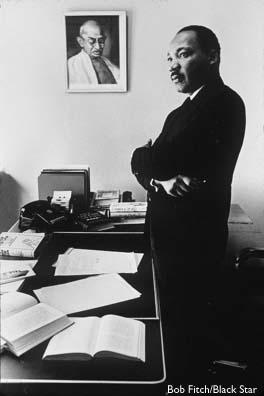
MARTIN LUTHER KING SPEECH

210,000 gathered at the Washington Monument in August 1963 and marched to the Lincoln Memorial, where the high point of the day was this speech by Martin Luther King. He had written it in longhand the night before and did not finish it until 4am.

"Five score years ago, a great American, in whose symbolic shadow we stand, signed the Emancipation Proclamation. This momentous decree came as a great beacon light of hope to millions of Negro Slaves who have been seared in the flames of withering injustice. It came as a joyous daybreak to end the long night of captivity.

But one hundred years later, we must face the tragic fact that the Negro is still not free. One hundred years later, the life of the Negro is still sadly crippled by the manacles of segregation and the chains of discrimination. One hundred years later, the Negro lives on a lonely island of poverty in the midst of a vast ocean of material prosperity. One hundred years later, the Negro is still languished in the corners of American society and finds himself an exile in his own land. So we have come here today to dramatize an appalling condition.

In a sense we have come to our nation's capital to cash a check. When the architects of our republic wrote the magnificent words of the Constitution and the Declaration of Independence, they were signing a promissory note to which every American was to fall heir. This note was a promise that all men would be guaranteed the unalienable rights of life, liberty, and the pursuit of happiness.

It is obvious today that America has defaulted on this promissory note insofar as her citizens of color are concerned. Instead of honoring this sacred obligation, America has given the Negro people a bad check; a check which has come back marked 'insufficient funds'. But we refuse to believe that the bank of justice is bankrupt. We refuse to believe that there are insufficient funds in the great vaults of opportunity of this nation. So we have come to cash in this check - a check that will give us upon demand the riches of freedom and the security of Justice. We have also come to this hallowed spot to remind America of the fierce urgency of now. This is not time to engage in the luxury of cooling off or to take the tranquilizing drug of gradualism.

Now is the time to make real the promises of Democracy.

Now is the time to rise from the dark and desolate valley of segregation to the sunlit path of racial justice.

Now is the time to open the doors of opportunity to all of God's children.

Now is the time to lift our nation from the quicksands of racial injustice to the solid rock of brotherhood.

It would be fatal for the nation to overlook the urgency of the moment and to underestimate the determination of the Negro. This sweltering summer of the Negro's legitimate discontent will not pass until there is an invigorating autumn of freedom and equality. Nineteen sixty-three is not an end, but a beginning. Those who hope that the Negro needed to blow off steam and will not be content will have a rude awakening if the nation returns to business as usual. There will be neither rest nor tranquility in America until the Negro is granted his citizenship rights. The whirlwinds of revolt will continue to shake the foundations of our nation until the bright day of justice emerges.

But there is something that I must say to my people who stand on the warm threshold which leads into the palace of justice. In the process of gaining our rightful place we must not be guilty of wrongful deeds. Let us not seek to satisfy our thirst for freedom by drinking from the cup of bitterness and hatred. We must forever conduct our struggle on the high place of dignity and discipline. We must not allow our creative protest to degenerate into physical violence. Again and again we must rise to the majestic heights of meeting physical force with soul force. The marvelous new militancy which has engulfed the Negro community must not lead us to a distrust of all white people, for many of our white brothers, as evidenced by their presence here today, have come to realize that their destiny is tied up with our destiny and their freedom is inextricably bound to our freedom. We cannot walk alone.

And as we walk, we must make the pledge that we shall march ahead. We cannot turn back. There are those who are asking the devotees of civil rights, 'When will you be satisfied?' We can never be satisfied as long as the Negro is the victim of the unspeakable horrors of police brutality. We can never be satisfied as long as our bodies, heavy with the fatigue of travel, cannot gain lodging in the motels of the highways and the hotels of the cities. We cannot be satisfied as long as the Negro's basic mobility is from a smaller ghetto to a larger one. We can never be satisfied as long as a Negro in Mississippi cannot vote and a Negro in New York believes he has nothing for which to vote. No, no, we are not satisfied, and we will not be satisfied until justice rolls down like waters and righteousness like a mighty stream.

I am not unmindful that some of you have come here out of great trials and tribulations. Some of you have come fresh from narrow jail cells. Some of you have come from areas where your quest for freedom left you battered by the storms of persecution and staggered by the winds of police brutality. You have been the veterans of creative suffering. Continue to work with the faith that unearned suffering is redemptive.

Go back to Mississippi, go back to Alabama, go back to South Carolina, go back to Georgia, go back to Louisiana, go back to the slums and ghettos of our northern cities, knowing that somehow this situation can and will be changed. Let us not wallow in the valley of despair.

I say to you today, my friends, that in spite of the difficulties and frustrations of the moment I still have a dream. It is a dream deeply rooted in the American dream.

I have a dream that one day this nation will rise up and live out the true meaning of its creed: 'We hold these truths to be self-evident; that all men are created equal.'

I have a dream that one day on the red hills of Georgia the sons of former slaves and the sons of former slaveowners will be able to sit down together at the table of brotherhood.

I have a dream that one day even the state of Mississippi, a desert state sweltering with the heat of injustice and oppression, will be transformed into an oasis of freedom and justice.

I have a dream that my four little children will one day live in a nation where they will not be judged by the color of their skin but by the content of their character.

I have a dream today.

I have a dream that one day the State of Alabama, whose governor's lips are presently dripping with the words of interposition and nullification, will be transformed into a situation where little black boys and black girls will be able to join hands with little white boys and white girls and walk together as sisters and brothers. I have a dream today.

I have a dream that one day every valley shall be exalted, every hill and mountain shall be made low, the rough place will be made plains, and the crooked places will be made straight, and the glory of the Lord shall be revealed, and all flesh shall see it together.

This is our hope. This is the faith with which I return to the South. With this faith we will be able to hew out of the mountain of despair a stone of hope. With this faith we will be able to transform the jangling discords of our nation into a beautiful symphony of brotherhood. With this faith we will be able to work together, to pray together, to struggle together, to go to jail together, to stand up for freedom together, knowing that we will be free one day.

This will be the day when all of God's children will be able to sing with new meaning.

My country, 'tis of thee, 
Sweet land of liberty, 
Of thee I sing: 
Land where my fathers died, 
Land of the pilgrim's pride, 
From every mountainside 
Let freedom ring.

And if America is to be a great nation this must become true. So let freedom ring from the prodigious hilltops of New Hampshire. Let freedom ring from the mighty mountains of New York. Let freedom ring from the heightening Alleghenies of Pennsylvania!

Let freedom ring from the snowcapped Rockies of Colorado!

Let freedom ring from the curvaceous peaks of California!

But not only that; let freedom ring from Stone Mountain of Georgia!

Let freedom ring from Lookout Mountain of Tennessee!

Let freedom ring from every hill and molehill of Mississippi. From every mountainside, let freedom ring.

We let freedom ring, we let it ring from every village and every hamlet, from every state and every city, we will be able to speed up that day when all of God's children, black men and white men, Jews and Gentiles, Protestants and Catholics, will be able to join hands and sing in the words of the old Negro spiritual, 'Free at last! Free at last! Thank God almighty, we are free at last!'