Monday, December 15, 2008

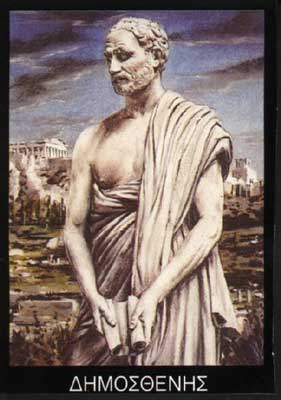
Demosthenes


1. There lived, a great many years ago, in Athens, one of the most renowned cities of Greece, a very celebrated orator, whose name was Demos'thenes.

2. But you will not understand what an orator is, until you are told that it means a person who speaks before a large number of people, to persuade them what to do, or to give them information, or good advice.

3. Thus, when a minister or clergyman preaches a good sermon, and speaks in such a manner as to please all who hear him, convincing them of their duty, and persuading them to do it, he is called an orator.

4. Demos'thenes was not a clergyman, or minister, but he spoke before large assemblies of the Athenians, and they were very much delighted to hear him. Whenever it was known that he intended to speak in public, every one was anxious to hear him.

5. Now, I wish to show you how hard he worked, and what he did, to become a great orator.

6. In the first place, then, he had a very weak voice, and could not speak loud enough to be heard by a large assembly; and, besides this, he was very much troubled with shortness of breath. These were very great discouragements, and had he not labored very hard to overcome them, he never could have succeeded.

7. To cure his shortness of breath, he used to go up and down stairs very frequently, and run up steep and uneven places; and to strengthen his voice, he often went to the sea-shore, when the waves were very noisy and violent, and talked aloud to them, so that he could hear his own voice above the noise of the waters.
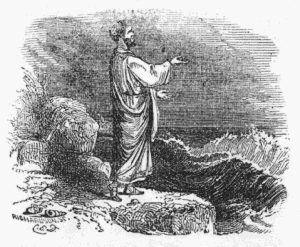

Demosthenes at the shore

8. He could not speak the letter r plainly, but pronounced it very much as you have heard some little boys and girls pronounce it, when they say a wed wose for a red rose, or a wipe cherwy instead of a ripe cherry.

9. Besides this, he stammered, or stuttered, very badly. To cure himself of these faults in speaking, he used to fill his mouth full of pebbles, and try to speak with them in his mouth.

10. He had a habit, also, of making up faces, when he was trying to speak hard words; and, in order to cure himself of this, he used to practice speaking before a looking-glass, that he might see himself, and try to correct the habit.

11. To break himself of a habit he had of shrugging up his shoulders, and making himself appear hump-backed, he hung up a sword over his back, so that it might prick him, with its sharp point, whenever he did so.
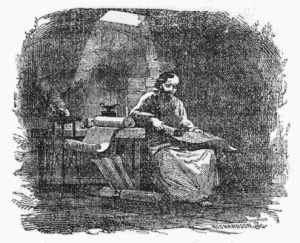
Shut in a cave

12. He shut himself up in a cave under ground, and, in order to confine himself there to his studies, he shaved the hair off of one half of his head, so that he might be ashamed to go out among men.

13. It was in this way that this great man overcame all of his difficulties, and, at last, became one of the greatest orators that have ever lived.

14. Now, whenever you have a hard lesson to read, or to study, think of Demos'thenes, and recollect how he overcame all his difficulties, and I think you will find that you have few things to do so hard as these things which he did.

15. When your teacher requests you to put out your voice and speak loud, remember what Demos'thenes used to do to strengthen his voice, and you will find very little trouble in speaking loudly enough to be heard, if you will only try.

This is an extract from www.gutenberg.org

The Orator - 3

Ages 50 to 59

When Demosthenes was 54 was honored by his admirers, with a proposal by to give him a gold crown. Aeschines then brought suit of impropriety. In a moving speech, Demosthenes defended his own career and attacked Aeschines of being an agent of the Macedonians. The verdict was soundly in favor of Demosthenes and Aeschines was obliged to go into exile.

Ages 60 to death at 64

The final years of Demosthenes were not his best.

Convicted

In 324 BC, at the age of 60, Demosthenes was convicted in complex and obscure affair involving money taken by one of the lieutenants of Alexander the Great. He was forced to flee from prison and go into exile.

The following year Alexander died. The Athenians recalled Demosthenes from exile and provided money to pay his fine so he could help throw out the Macedonians. They also rose up against supporters of Alexander, including great philosopher and scientist Aristotle, whom they convicted to death.

Sentenced

For the next several years Demosthenes spoke out against Alexander's successor, Antipater. But his efforts to overthrow the new leader failed. To protect the city from the wrath of Antipater, Demosthenes' former friends persuaded the Athenians to sentence to him death.

Death

[Illustration]

Death of Demosthenes

In 320 BC, at age 64, Demosthenes fled the city and was pursued by Antipater's soldiers. He then killed himself by taking poison before he could be captured.

Epilogue

When we think about his early life and his hard work to overcome his weakness such as stammer we will be clear with one thing i.e. hard work makes every thing possible and when we observed his successful career as an orator we can get with some important points to remember i.e. dedication, love and sincerity towards the work will get you to heights.

As a final point of this post I would like to say one thing to you that is worth remembering ‘The word is mightier than the sword’


The Orator - 2

Ages 30 to 39

While in his 30s, Demosthenes built his political reputation.

Demosthenes at the shore

Gave first major speech

In 354 BC, when Demosthenes was 30, he made his first major political speech before the Athenian Assembly. His logical oration helped persuade the Athenians to build up their naval strength to show others they were willing to defend themselves. The speech was a great success.

From this point on, Demosthenes' career was concerned with Athenian foreign policy. It was not very long before his oratorical skill and fervor made him a political leader.

The Assembly environment

The Athenian Assembly was a loosely organized body of up to 6,000 male citizens. They would shout down a speaker they did not like and some would ridicule their rivals. Any citizen could speak, but only the best orators survived for long.

Had sharp wit

Among the speakers, Demosthenes stood out. One reason was because of his severe and perhaps forbidding personality. He also had a wit that was exceptionally caustic. He realized the advantage of making an audience lose respect for his opponent. Although he gained many supporters, he also made many enemies in the process.

Was a patriot

Demosthenes was a student of Greek history, and he used historical parallels in many of his public speeches. He would arouse emotions by asking the Athenians to recall their history, belief in democracy and hatred of tyrants. His love of democracy came forth in his speeches.

Was industrious speaker

Demosthenes was also very industrious. He would sit down at night and go over the conversations and speeches he had heard during the day, experimenting with various replies or speeches that could have been made. Although he excelled when he could prepare his speeches carefully in advance, his thorough preparation gave him the ability to respond to an opponent's remarks on the spur of the moment.

Against King Philip

When he was 33, Demosthenes delivered a speech against King Philip of Macedonia. This established him as the leader of the opposition to Macedonian ambitions. Over the next several years, he gave speeches trying to arouse the Athenians against the Macedonian threat.

When Demosthenes was 38, in 346 BC, Philip and the Athenians agreed to peace treaty. Demosthenes went as one of the ambassadors to negotiate the treaty with Philip. During the negotiations, Philip recognized Demosthenes' eloquence as a threat to his plans, ignored him and addressed his fellow ambassador Aeschines instead. The two men returned from the embassy bitter foes.

Ages 40 to 49

When he was 41, Demosthenes gave a speech accusing Aeschines of political misdeeds and accepting bribes. The court, however, acquitted Aeschines.

Against Macedonians

For the next several years, Demosthenes continued his speeches against Philip and the Macedonians. The speeches--although moving--were ineffective in the fight. The Macedonian army was well organized under a single brilliant commander who used cavalry in coordination with highly disciplined infantry, while the Greek alliance depended upon what was essentially a group of citizens' militia.

When he was 46, in 338 BC, Demosthenes fought in a battle against the Macedonians but fled after dropping his arms. The Macedonians won the battle and defeated allies of Athens. Although disgraced, the people of Athens still chose Demosthenes to deliver the funeral oration for those slain in the battle. Philip refrained from occupying Athens, because he knew it had was a strong pro-Macedonian factor. Demosthenes then came under several forms legislative attack by Aeschines and his followers.

Alexander takes over

In 336 BC, Philip was assassinated and his son Alexander succeeded him. Alexander had been educated by a pro-Macedonian resident of Athens, Aristotle. Soon he would be known as Alexander the Great, because of his conquests.

When the when the city of Thebes rebelled against him the following year, Alexander destroyed it. After a string of victories, Alexander then demanded that Athens surrender. Demosthenes and seven other orators who had opposed Philip approached Alexander and convinced him to have that order rescinded. Alexander then began his invasion of Asia and left Athens free of direct military threat from him.

The Orator - 1

Demosthenes (384-320 BC) was one of the greatest orators in ancient Greece and a contemporary of Plato and Aristotle. He was motivated to overcome a speaking handicap and learn to write logical and moving speeches. His skill in being able to deliver his speeches with conviction allowed him to become a political power in Athens. But his political work also led to his downfall.

Birth to age 19

Demosthenes was born in Athens, Greece in 384 B.C. to a wealthy family. At the age of seven, his father died and he was put under the care of guardians.

He had a delicate physique that prevented him from receiving the customary Greek gymnastic education.

Ages 20 to 29

When he turned 20, Demosthenes realized that his large inheritance had been squandered by his guardians. He was now without a means a support.

Angry at being cheated and put in a difficult position, Demosthenes sought to sue his guardians in the courts. In 4th-century democratic Athens, every citizen who wished to prosecute a lawsuit or to defend himself against accusation had to do the speaking himself in court.

Motivated to study speaking

His strong desire to sue the scoundrels led him to study legal rhetoric and train himself as an orator.

Had speech defect

The problem was that Demosthenes had a speech defect. He was inarticulate and had a stammering pronunciation. He sought to overcome his handicap by practicing speaking with pebbles in his mouth. Doing this forced him clearly enunciate his words, instead of rushing and stammering. He learned to control his speaking.

Demosthenes also practiced reciting verses when running or out of breath. Again, he was able to control his speaking, as well as his breathing. Another thing he did was to practice speaking before a large mirror. In those days before microphones, the speaker had to have a strong voice and use dramatic gestures for effect.


To overcome a stammer he recited with pebbles in his mouth. He matched his orations with the thunders of the Aegean Sea that his voice might gain volume. An ugly hitching of the shoulder he corrected by standing beneath a suspended sword. He corrected any facial distortions by practising in front of a mirror.

Needed logical content

Despite this self-improvement program, his first speaking efforts in public were a disaster, and he was laughed at by his audiences.

Demosthenes saw that besides being able to present himself before an audience, he also needed to learn to write logical, meaningful speeches. This was especially important to win the court case.

Result of lawsuit

When Demosthenes finally presented his case in his lawsuits against his guardians, he was more successful. Although the lawsuits produced little money, he learned much about speaking strategy and the methods of argument.

Became speech writer

His rhetorical skill in the lawsuit had been noticed by some wealthy men in need of a speech writer. Demosthenes soon acquired powerful clients willing to pay well for his services.

He continued a career as a speech writer, learning much about the Athens politics in the process.

Became interested in politics

When Demosthenes was 28 years old, King Philip of Macedonia--same age as Demosthenes--started to annex Athenian possessions. Demosthenes was very patriotic and concerned about these events, as well as other threats to Athens.

The Orator


Cover

Today I would like to discuss with you about one of greatest eloquent and skilled public speakers till date. He was who overcame his stammer by the means of continuous hard work and he was who influenced the entire nation with his incredible orations which were even popular and considered as classics.

He achieves an astonishing intensity, variety, and freshness of emotional expression. He never lets his audience anticipate what he will say next. No one creates periodic sentences longer or more complex, or so skillfully suspends the conclusion of a thought. No one has a better instinct for when to vary periodic structure with simpler sentences, or when to break off with a single word. No one better handles the thrust and parry of rhetorical questions and answers, sarcastic asides to and about his opponent, and sudden exclamations. No one can shift his tone so swiftly or with such effect.

He was none other than Demosthenes.

Now I am here with his biography which was presented in short.